By Dominic Piacentini | University of Maine
The Anthropocene poses new challenges to those who engage in subsistence activities. In Appalachia, as vast acres of land are either seized for the extraction of natural resources or set aside for the protection of them, many continue ‘the old ways’ in whatever land they can safely access.
This paper asks how and why folks continue to gather wild-growing foods despite spatial lockdown. This paper addresses calls to observe practices of commoning in the global north and attends to the ways gatherers turn the challenges of the Anthropocene into creative opportunities for collective living. Although much of the land in Appalachia is held by absentee corporations, the mountains have long functioned as an open-access, de facto commons. Literature on Appalachian commons often focuses on native forest plants and the threats extractive industry poses to them. I propose engagement with “wasteland commons” to understand how similar commoning practices persist beyond these idealized environments and into the contaminated spaces of modernity.
To further the concept of wasteland commons, I draw upon gatherers’ experiences with three tropes of ecological nihilism that often dominate discourse on both the Anthropocene and Appalachia: invasion, toxification, and ruination. Invasion involves the spread of invasive species, toxification involves the gradual accumulation of harmful toxins, and ruination involves the blasting of landscapes. These three tropes can render entire environments unrecognizable, but the dangers of ecological nihilism are that we condemn these spaces to abandonment and further destruction. Through commoning the wastelands, we generate paths through them.
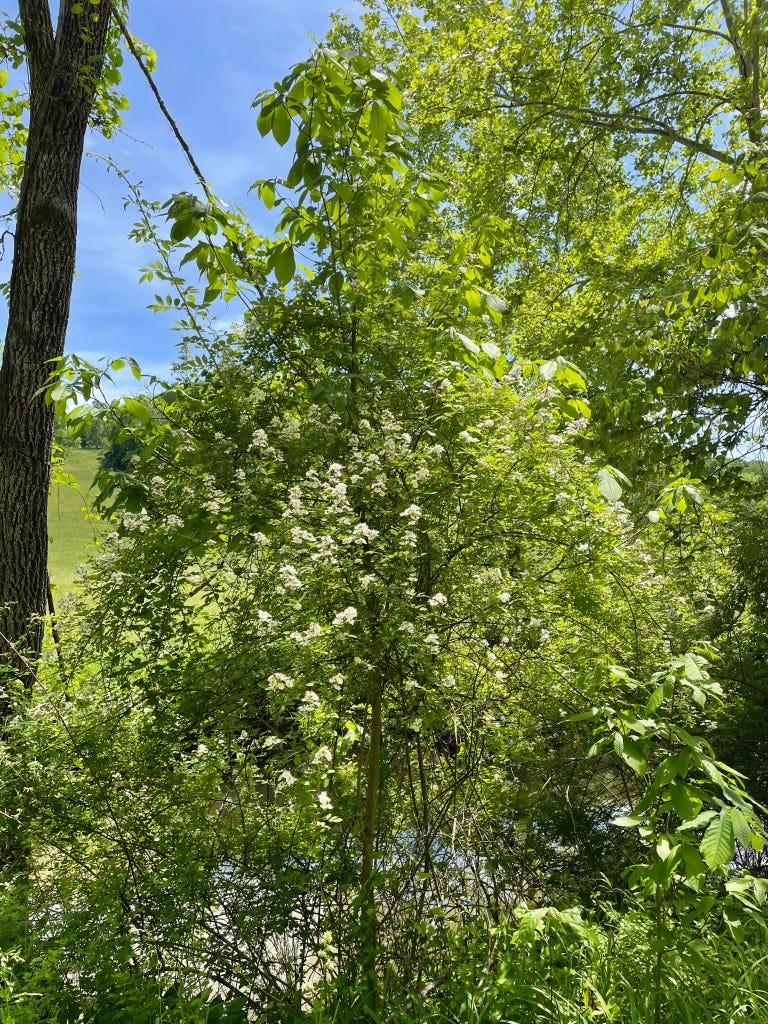
Figure 1. Roadside multiflora rose, in bloom, climbing up a pawpaw tree. Photo by the Author, 2022.
As environmental anthropology has turned its attention from the commons to commoning (or the commons in action), old debates about property, production, and landownership have been reinvigorated. Imbued with indigenous-led critiques of state power, settler colonialism, and private property, stories of the commons have taken on new character and new characters. Frequently, these conversations now circulate around multispecies partners in the making and breaking of property.
As an example, across the rural United States, plants like multiflora rose were first deployed by federal agencies to serve as “living fences,” imagined partners in 20th Century enclosure. But these plants quickly expanded beyond the role of fence, proliferating to the point that they are now observed to be “invasive species” by the same organizations that introduced them. Multiflora rose, as it turns out, is not the willing environmental subject it was expected to be. Once a tool of property making, multiflora rose has become a problem for property as it encroaches upon agricultural fields and meadowlands.
My interests as a researcher have revolved around overlapping and inconsistent preoccupations with private property as both a mode of law and a unique cultural practice. In the global north, where settler colonial logics have become de jure, private property values are assumed to be “common sense.” And yet, they are far from absolute. I have primarily conducted research in central Appalachia — a largely forested, mountainous cultural region of the eastern United States whose image has historically been limited to fossil fuel extraction and patterns of economic underdevelopment. What makes studying property relations here so interesting, though, are the overlapping and co-occuring de facto, open-access commons.
Appalachian commons have been observed to be roughly congruent with two overlapping spatial geographies: (1) vast regions of corporately owned land, prized for potential value in minerals, timber, or real estate, and (2) biodiverse, mixed-elevation forests that are infilled with an array of wild-growing forest foods and medicine. Economically valuable plants like ginseng and ramps receive a lot of the attention in this space, but there are also pawpaws, mayapples, chanterelles, and myriad more. These assemblages of multispecies plants and mushrooms lure their gatherers across property lines, into fields and forests they do not own.
In May 2022, as Marion Harless (an expert in all things green and growing) and I discussed the looming abundance of serviceberries, she reflected on her childhood: “When my dad wanted to get rid of us,” she says, “he’d tell us to go gather serviceberries in the woods. Now, those were the commons. I had no idea who owned those hills.” Growing up in the woods, Marion was never certain who owned the land around them, but that never stopped her from escaping into the hills with her siblings.
“People would just use the woods,” she says, “I grew up in those woods. Now, who did those woods belong to? I have no idea. We had ten acres, which is a lot in West Virginia. But we were in the woods all the time. We picked blackberries to sell, my brother and sister and I, in somebody else’s field up on top. There weren’t any houses. There weren’t any people. It was just the woods. The woods.”
The woods that Marion recalled from her childhood are emblematic of the de facto, open-access nature of Appalachian commons: the common places up on top, where people could gather and picnic together. In Marion’s case, blackberries and serviceberries drew her and her siblings there, beyond their ten acres, and through stories of gathering there she conjures a narrative geography of kinship in the commons.
In the paper, I present a case to observe similar patterns of commoning not only in Appalachia’s idealized mountain forests — the kind Marion recalls from her childhood — but also in the ordinary, cruddy spaces of modernity — on the sides of roads, in fallow fields, and in development sites, places where multiflora rose blooms abundant. I do this to demystify commoning, focusing on seemingly ordinary behavior in seemingly ordinary places. Oftentimes, these environments display emblematic characteristics of the Anthropocene — invasive species, toxic runoff, and abandoned infrastructure. On their surface, these spaces may appear empty, or at least empty of anything good. But to those gathering there, that is far from the case.
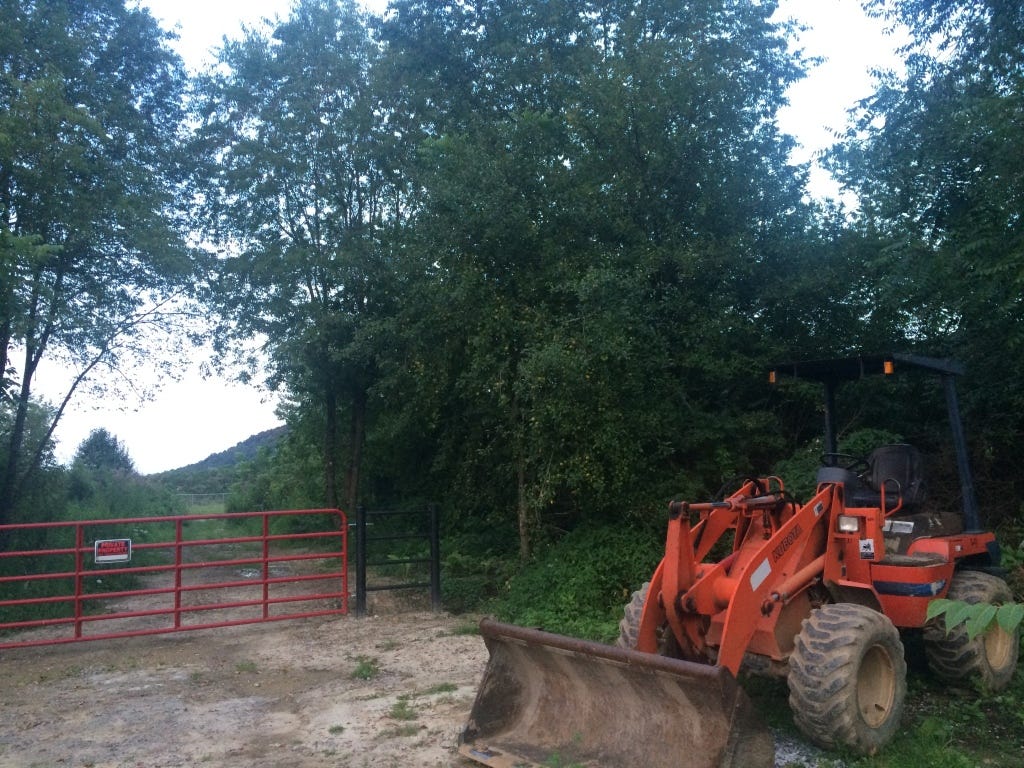
In my research, gatherers have taken me into Appalachia’s highland forests to cut ramps and hunt hedgehog mushrooms. They have shown me how to make salves and lotions from native, understory trees like witch hazel. But gatherers have also taken me to pick pokeberry leaves beside abandoned airplane hangars, pick elderberries in rail yards, and make tinctures of roadside invasives. While these places may appear less desirable, they are not empty. They are important sites where gatherers and the plants they follow challenge the primacy of private property.
 synthetic zerØ
how does using abandoned places challenge private property?
By becoming spaces where people can collectively improve their situations without the need to own land — at least that was the gist I got from it.
but how does that undermine anything outside of these abandoned places?
In several ways. The most interesting being as demonstration sites for possible alternatives, and as commoning spaces for the possible generation of countervailing embodied subjectives (via praxis of commoning and experiementing at the margins).
I understand your skepticism, but it is the ‘cracks’ (in liminal spaces) that let the light in. Or, tiny windows of opportunity for mutation can breed monsters vicious or caring enough to challenge.
There is no one kind of space or tactic that will do the trick. We need multiple spaces of possibility and many tactics and strategies to bring down the pathological creep of leviathan.
that would take scaling/organization never seen before in the history of the planet at a time when international politics is more fractious then it’s been in decades and national governments are struggling just to keep running… Maybe better to focus on these areas as places to learn to make do with less and less as that’s what will be available as the big machines implode…
Why is the agenda you propose opposed wasteland commoning? I see them as the same thing: creating commons at the margins, and at the, as places for 1) learning how less is more, as leaing into the back loops/”collapse”, 2) creating alternatives to resist dominant systems, and 3) demonstrations sites to inspire alternative “compositional apsirations” (Bratton). It’s a both and situation as I see it.
Wasteland commoning is exactly the prefigurative approach needed to both resist (for later resiliency) and “collapse now avoid the rush” (which I see as ‘adapt now, avoid the rush’).
nothing about wasteland communing could actually resist the powers (if they decide to reoccupy the territory)that be nor offer a viable alternative to (in the here and now) to the market-machines (one would still be both dependent on and exposed to the powers that be). If and when things really unravel then will be good to have some practice living under such deprivations.but of course when lots of people on on the move and scavenging then settled outliers communities will be vulnerable to the hordes…
Sure, maybe. Depends on which wastelands and what populations.
“When you say “nothing about wasteland [commoning] could actually resist the powers (if they decide to reoccupy the territory)” I can’t think of any reasons THE POWERS would want such sapces — the are wastelands… Meanwhile wastelanders are relating their relata into new kinds of people with new/old ways of gettining by. Practicing, as you suggest, a destitute lifestyle as we slide into the real deal.
Wastelanders who common together defend together, as so on…
well the native folks here were forced onto reservations that were considered wastelands and then all kinds of minerals and the like were discovered and the occupations began again, but my point going back to the original post is that none of this equates to a threat or even resistance to the powers that be and their ways of organizations. They are the only real threats to themselves and they are really going at the self-destruction so people should buckle up.
There are many ways to pose a real threat, only people are too dependent on wage labour to pursue them.
My point is only that the project is not to be a threat at all, but become an alternative + prepare via forms of collectivizing and degrowth-ing for the self-destruction of “civilization”.
That’s yer point now and that’s fine, but the post (and so my initial question) said:
“They are important sites where gatherers and the plants they follow challenge the primacy of private property.”
Which I think it still does – all commons do.