REPOST FROM 2015:
In the last few months I have begun to explore philosophical pessimism, although not in writing and not on syntheticzero. It might seem strange to do so now, given that syntheticzero is above all a site dedicated to the exploration of ideas and practices that we have decided to group together as post-nihilist praxis. The term “post” requires no lengthy exegesis, it simply serves to indicate that our exploration of praxis is taking place after nihilism. In certain respects it could be said that this self-important designation- “post-nihilist praxis”- is merely the jumped up rebranding of existentialism carried out by a bunch of people who aren’t merely para-academic but exist nowhere near inside the academy.
Perhaps it is necessary to refresh ourselves briefly on the nihilism that the curators of this blog think has taken place. We are committed to a certain set of epistemic outcomes of scientific discovery. To phrase this in another way we fully affirm the negativity of the nihilism unleashed on the world by capitalism. We are against all and any attempts to therapeutically, immunologically or nostalgically deny these realities. Such denialism must be regarded as the disavowal of reality in favour of a psychotic hallucinatory-delusional substitution of that reality. As such explorers of post-nihilist praxis often speak of being against Transcendentalisms, or the reactive attempt to cling to models of sacredness that have become emptied of their content- even if they retain the dangerous vitality of desperation. Consideration of these truths must extend to their consequences for ethics and politics, no matter how uncomfortable this might be. If we maintain any unquestioned advocacy of positions traditionally associated with our own theoretical, political and ethical backgrounds- whether these be around our philosophical readings, our inherited values, or our activism and/or professional ethics.
Is it really so easy to forget that nihilism? Is it really so easy to forget the multiple and convergent streams of nihilism that Nietzsche described as a slow burning but ultimately violent catastrophe. In an early version of my own attempts to write- to write to understand, dis-invested as I am from academic thought- I called my own appreciation of the concussive blunt force trauma of nihilism “catastrophic thought”. Is it so easy to forget such a catastrophe? We are already like the neurology patient admitted to the hospital after a car crash and who now cannot remember what happened to him. How did we get to this hospital bed? And the nursing staff have to try to cajole us to stay in the bed or at least on the ward, telling us again, an edge of irritation in their voice, that we have had an accident and that it isn’t safe for us to wander off. Except that we have not just had an accident, we are an accident. Except it in Nietzsche’s image we have not just been hit by a car- a few broken bones and some slight disorientation- but we have been fundamentally pummelled by the lunatic potency of nature:
For some time now our whole European culture has been moving as toward a catastrophe, with a tortured tension that is growing from decade to decade: restlessly, violently, headlong, like a river that wants to reach the end wants to reach the end, that no longer reflects, that no longer wants to reflect
Here is Nietzsche describing the slow catastrophe as also a hurtling vortex that shreds everything in its path, everything in its way, a river that having burst its banks will rage onwards to tear down homes and ruin infrastructure, drowning children and animals and the strongest men, dividing us up into the drowning and the drowned. The violence of river bursting its banks in the amphetamine image of a hyper-disaster conjured up by the catastrophizing imagination- the catastrophe doubles itself in thought- is one that tears bodies to shred as easily as concrete. If Nietzsche had access to the apocalyptic imagination of our cinematic disasters he might easily have spoken of a tsunami, and pictured the giant waves that sweep across an new York, leaving a scene of total devastation in the eerie silences of a dark submerged world. That world would go on to freeze over and become totally inhospitable to human bodies. If the film is hilarious in the way all this takes place in a few minutes- the freezing over of the cold world taking seconds- then Nietzsche’s torrents take a life time or more to wash away all the structures in their path. Like a blast-wave in slow-motion, the river that no longer reflects unleashes the invisible geological powers of erosion before finally accelerating and revealing itself in its terrible sublime power.
In the image of the river Nietzsche provides a dark naturalistic metaphor that doesn’t pretend that humanity can ever erect any sovereignty over nature. All our dwellings, whether little houses on the horizon or the skyscrapers of our dreams of a vertical colonialism of the heavens, will be undone by the necessary and inevitable monstrosity of the churning wall of water. And with it everything will be swept away from us, all the familiar trappings and stage-setting of home and familiarity, of the heimlich. Here we can move from the cinematic images of The Day After Tomorrow to the realities of the immediate post-Katrina situation

In the aftermath of the hurricane, and amidst the abandonment of the civil and political authorities of the black population to fend for itself, the entire landscape is fundamentally altered. It becomes obliterated of its richness and its detail and the human figures, at least in this aerial shot, are completely disappeared in favour of a weird abstract landscape that resembles nothing so much as a circuit board or some rocks jutting out from wet sand at the beach.
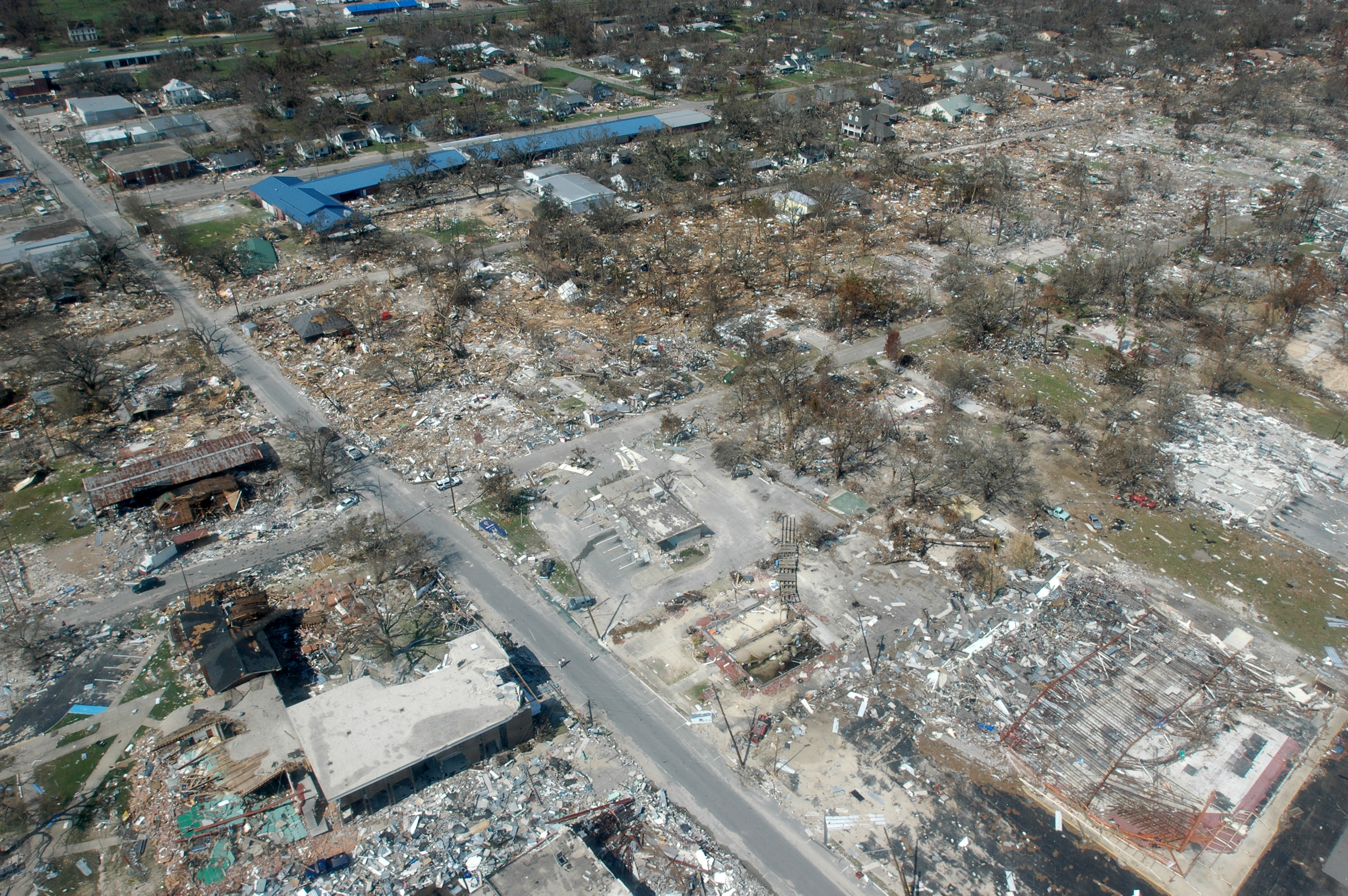
Once the water recedes the landscape is shown in the full extent of its ruination as every habitation is rendered into the grainy botches of colour that suggest what was once a wall or a window, leaving only the carcasses of buildings or the architectural outlines of where a building used to be. The road cuts through the scene in the image above but now as a pure scission that lacks any sense of logistical connection to a wider machinery of civilisation. The city, as space of human and nonhuman vitality, goes silent in the aftermath as the places of exchange and sports games and garrulous late night drinking, dark corner drug deals and violence, animal copulations, infrastructural buzzing and industrial humming, the machinic sonic landscape of the motorway and the automatic door- in short the inhumanism of “urban living”- goes silent. For a while after the initial deluge and prior to the panicked frenzy of terrified survivors the city resembles nothing more than an Anselm Kiefer canvas:

This is the only painting to have ever made me cry. I am perhaps an insensate philistine who just doesn’t get high art. It’s possible. It wouldn’t bother me if it were true, except insofar as some image of a cultured man haunted still haunted me. I was in my 20s. I was a depressive young man. At first I couldn’t see what I was looking at. Then the large canvas began to resolve itself: the perpendicular image, looking down from above, and the scrubbed out, wasted, cancelled outline of a city that began to disappear as it rose upwards, as if stretching above the earth would lead to an auto-destruction in ephemeral indistinction, the city just evaporating as it refuses to fuse with the sky, thereby undoing even the most terrestrial orientation points of the endlessly cited “horizon” and all its weight of tragic finitude, all from the impossible subjective perspective to which I, as viewer, was joined . Of course it wasn’t so long after 9-11 but I feel that the reason I cried was much more than this proximal-social event, no matter how horrific. The painting, with its inclusion of barbed wire (security; weapon) and dirt and sand (rubble; remains) seemed to exceed the constraints of spatio-temporalisation in any one place or time. It seemed as if this were the view from the Will, as if this were the cannibalistic and utterly inhuman destructiveness of the horror in itself, the despair in itself, the sorrow in itself, of the world looking down upon its own representation and attempting to undo it all in one flight. The image in its full reversibility: are these ruins or buildings still under construction? Was I witness to a quiet world-without-us or destructive angel ushering in a world fundamentally posed against us?
The blurb from Tate goes like this:
This horrific vision of urban sprawl was inspired by Kiefer’s visit to Sao Paulo in Brazil. Tangled copper wiring signals the breakdown of communication. The city is engulfed in an apocalyptic haze, which Kiefer created by spreading dust and earth across the painting, then burning parts of its surface. According to Hebrew mythology, Lilith was Adam’s first wife, a seductive and demonic airborne spirit. In Kiefer’s painting, Lilith seems to bring destruction from the air upon Oscar Niemeyer’s modernist buildings.
A breakdown of communication. The end of transmission. Isolation. Lilith the First Woman. The rebel against Man who came not from his body. The Patron of Abortions. Her name meaning chaos. She who is represented as a she-demon throughout mythologies. She of whom it is written in the Dead Sea Scrolls’ exorcism text Song for a Sage
And I, the Sage, sound the majesty of His beauty to terrify and confound all the spirits of destroying angels and the bastard spirits, the demons, Lilith. . ., and those that strike suddenly, to lead astray the spirit of understanding, and to make desolate their heart.
In the moments of the collapse during which everything is sunk in a state of submergence there is only the strange thick and heavy darkness that weighs down on bodies and makes their every movement- unless they have been adapted for the water- too slow. In the heavy darkness where dark bodies move with eerie effort and one cannot breathe a bizarre choreography takes place among alien organisms that glow with their own sickly illumination. Then the waters recede. The flood is over. There was no ark. What survived? Where am I? How did I get to this place?
If I have gone too far with the liquid analogy, morphing it from streams to furious bank-bursting river, to crashing tsunami, to demons of gnostic and Talmudic origin, to the depths of the midnight zone before letting it slip back into nothing so dramatic and over-wrought as the Biblical Flood, with a little moment of tender self-dissolution thrown in along the way, it is because the explosive impact of the annihiliating forces of cognition cannot be overstated. Indeed, in other contexts the word apocalypse might be deployed, where it not that the word implied some impossible final seeing through things to the world as it is without us. All of this might be regarded as just excess were it not for the fact that it perfectly captures this destruction.
The flood is the drowning is the asphyxiation of the human being that lies at the heart of humanism and religious thought and which carries on only as the little corpse propping up an even smaller hallucination. The outcomes of the corrosive acid flow of Nietzsche’s predicted nihilistic torrents need to be remembered once again. Here they are posited as fundamental presuppositions around which we oriented our poor and self-indulgent thinking.
First of all that there is no meaning to existence. There is absolutely nothing meaningful about our existence and even the idea of speaking of lives that matter to anyone except those who are doing that living is an excessive indulgence. This denial of meaningfulness ultimately extends to any full blown existentialist sense that we can or should construct our own meanings via the establishment of a Big Project. We are of course all involved in projects if these are considered on the small scale: they range from getting dressed in the morning, to making coffee, to going to work, to getting drunk, to paying a mortgage. From the perspective of my understanding of this for post-nihilist pragmatics it means that there is no ultimate way to differentiate any activity from any other. All supposedly meaningful human activities are equal to one another insofar as they are all ways of coping with being alive. A friend of mine gave me a wonderful quotation from Frank Sinatra to express this levelled equality of coping mechanisms:
Basically, I’m for anything that gets you through the night – be it prayer, tranquilizers or a bottle of Jack Daniels
If it has any more elaboration or specification in different contexts (ie. the dualism of the hyphenated with” indicating one is potentially both coping with and coping by means of) this is the basic ground floor sense with which I use the term coping.
This is identical to the same idea expressed by Thomas Ligotti that whatever a human being is doing s/he is merely trying to kill time. This insight comes to me with the highest weighting for praxis because it implies that there is no good or bad way to cope, there is only appropriate and inappropriate ways; or, if that is too abstract at this first pass, we could say that there are more or less harmful modes of coping-with being alive.
To be even more concrete I will provide an example from my working life. I work with drug users who will come into my clinic with all kinds of moralism in their heads, and this moralism that they have introjected from society- coming forth in judgements that “I am scum” or “I don’t deserve to be alive”- is often precisely what keeps them in the throes of an escalating drugs addiction. I will work with many of these clients in an effort to extract this noxious moralism so as to undo its destructive effects.
One of the first and most modest ways I try to do this is by pointing out to the client that his heroin use is identical to another person’s gym obsession and a third person’s drinking every night or a fourth’s practice of Buddhist meditation techniques. All of these practices are attempts to cope, the difference for my client is that her coping mechanism has become excessive and has narrowed her existence to one obsessive and eclipsing ritual. Almost all of my clients will tell that they are coping via the protocols of neurochemical escapology and almost all of them are- by the time I see them- completely sunk into the chemical dystopia described by Deleuze an Guattari:
Drug addicts continually fall back on what they wanted to escape: a segmentarity all the more rigid for being marginal, a territorialisation all the more artificial for being based on chemical substances, hallucinatory forms, and phantasy subjectifications (285).
I don’t want to dwell on addiction here but I feel like we could criticise Deleuze and Guattari here for seeing only the segmentarity of the drug addicts- curious use of a facialised expression- and avoiding the wholeness that the drug using body is raised up to when it is “high”. It may be that in a separate post it will be necessary to explore how the immersion into chemical states is identical with the desire that has in other times and places been seen as the experience of a oneness with God. The invulnerability of the heroin user as it is expressed in something like Cain’s book certainly does not resemble the image given by D&G. This extended aside on the drug user may seem unnecessary- and it is- but it allows us to discuss the meaninglessness of existence from another side.
The bad segmentarity of the addicts life can be imagined according to this composite description: wake up and search for any dregs of last hit; cook up and take a charge; start thinking about where to get the next hit; go and do the stuff one needs to get the money to get the next hit; find somewhere to take a charge; undergo processes of immersion into the full emptiness of the tranquillity of heroin’s “gouch”; repeat. This picture will obviously vary widely but this is the classic generic picture (ie. all the variances have been abstracted from it) of the addict’s day. In addiction one is either high, anticipating the high or one is in a state of withdrawal.
One is either in the rituals of getting or being or coming down from equilibrium. In the final analysis the bad segmentarity of the addict is just an accentuated version of what all of our days look like. Indeed the addict may be more fully engaged in her project despite the fact that she is aware that there is absolutely no meaning in her activity whatsoever. The addict’s immersive oblivion strips their world of emotion and distressing memories, forces away any cares or terrors and provides her with a complete and total experience that we- as non-addicts from the outside- can only understand as escapism. But this is precisely what each of us is doing, except that we are attempting to get at meaning while the addict understands that there is none to be had and actively enacts that meaninglessness.
Indeed, the addict might be the most honest human being there is as she injects chemicals into her body to get at a state of temporary enlightenment, cutting through all the bullshit that surround the demands for being productive or engaging in a community and so on. We try to uncover mediate jouissance through sublimation in activities like writing and thinking- and forming communities to tell each other how clever or stupid we each are. The addict’s jouissance is chemical and machinic and immediate and doesn’t pass through any outside or other. The addict’s problems begin from the outside and the standpoint of a society of lunatics that jealously guard the right to access the fleeting state of oblivion. The problem reaches its crescendo in the fact that the addict is the perfect image of the Buddhist desire not to desire. That the addict is hooked means that she is never able to fully immerse herself into oblivion whilst simultaneously being unable to remain in her own personological prison; she is caught in a cruel movement between escape and imprisonment just as in Schopenhauer’s account of existence as a pendulum swinging between boredom and despair.
So let’s be clear that the nihilism of contemporary thought- and here we are talking about the scientific or Enlightenment reason- reveals to us that there is absolutely no meaning to anything we do. This means that there is also no meaningful conclusion to our existences. The pain and misery that we endure is utterly pointless. The dead and mutilated bodies of history pile up upon each other in a mountain of flayed flesh and electrocuted brains, as images of dead Syrian children flutter across our screens, and executions are consumed as spectacle and our every action assists in the reproduction of a malignant social system that murders and devours countless lives…and none of it matters, none of it ever reaches a moment of redemption. Even if the communist historical utopia is achieved this does nothing to redeem the deaths and the suffering. It remains pointless to all but those who cradle those lives in their arms. Whatever false image of redemption there is must always be local. It can only ever be the redemption of those I know and love or at least have come into some kind of contact with. Against all the sentimentality of warm feelings for the species it is impossible for me or you to care about the unknown person x who at this moment is doing something we do not know what. If that sounds banal and obvious then let’s move on.
Without meaning and without an historical horizon of retroactive meaningfulness (redemption) there is also no sense in which things have a point. This may risk repetition but it twists itself away from meaning to move towards purpose. What’s the point? is a question asked by the resigned and the depressed, those who know there is no use to any particular action, or at least no transcendental criteria against which to measure the usefulness of any action. Here we are again at the equality of coping mechanisms. To say there is no point is to say that all action is equivalent and as such is equally equivalent with no action at all. There is no intrinsic reason for reading rather than getting high and perhaps given a different set of local or proximal determinants and a different position in the chaotic web of causality we would indeed be shooting up right now.
As a consequence we are forced to ask why it is some of us value working for others or for even for ourselves. Here I mean to question many of our immediate and reflexive political positions. Those who work for freedom or liberation or a just society are those who Max Stirner declared as haunted by normative abstractions. To update the language we can say that these are psychotics who are more attached to hallucinations and delusions to flesh and blood. If we criticise them for this we have to recognize that that too is pointless. The great causes of the left are not to be taken as automatically and obviously valuable or worthwhile. If there is no meaning and no point to human life then why in the hell should anyone care about equality or justice? The only answer might be that a friend gave me when I asked him why he was a socialist: “because I like those things and think other people I like should have them too”. The tricky thing about his honest answer- which isn’t to suppose all other answers are lies- is that the same could be said of aristocracy. The outcome of our exposure to the nihilistic radiation might be that our commitment to the left, insofar as we have one, is disrupted, disturbed or even destroyed.
All of this segues with the absence of any intrinsic purposes in the cosmos. It is not just humans that lack any reason to exist but everything. Every material existent exists on the basis of a pure contingency and equally may as well not exist from the stand-point of being. This means that there are no human or animal intentions and that there are no historical goals or cosmic teleology. Tempting though it is to claim that the teleology of everything is its own apocalyptic destruction- insofar as everything that exists seems to be impermanent and therefore moving ceaselessly to its death- this might simply be pushing the facts of what will happen to our bodies onto a cosmos that might be infinite and eternal. The realities are that we do not know, although we are all aware of Ray Brassier’s scientifically backed speculations to the contrary.
If there is a purpose to human life it is immanent to our biological make-up. As such the most robust concept of purpose we can have is that given to us by the crudest of biological reductionists and evolutionary psychologists- that is those who have made peace with Darwin’s dangerous idea: that we are here quite by accident and for no supernatural or supernormal reasons, and that while we are here we are, most of us and most of the time, compelled to survive in order to reproduce. And when we reproduce we do it for no reason- although just like the addict, or the dementia patient who performs actions entirely without conscious intent, we’re able to come up with plenty.
We are meat processing information carrying bundles of information across time and places. We are prompted to do things because they feel good or- more often- because we want to avoid things that feel bad. This is the brutal and blunt stupidity of our existence as neurologically advanced- in our own estimation at least- hominids. As meat-information machines we generate for ourselves a sense of self that we carry around with us and occasionally update as required. We cling terribly to this little hallucination as if it mattered and routinely cling to the hallucinations of others as if they mattered at all. This usually results in the formation of in-groups and out-groups and the adherence to a set of memes or cultural systems that anchor us together in these groups. The seeming purpose of these group formations is to allow us to better bind together in order to survive and reproduce. There are a number of ways this can be carried out and some are more hierarchical or egalitarian than others. From this perspective every single article of philosophy and every single grouping whether fascist, communist, women’s institute or football team is a surrogate or substitute for the absence of meaning, purpose and the exposure to corporeal and ontological vulnerability that is signified by the word “death”. All our death denial systems are security systems or shelters and bunkers in which our little sacks of meat and chemicals, with their fibrillating tissues suffuse with an electricity that will cease without adequate levels of potassium. hunker down and hide.
Potassium is more important to the human being than any amount of freedom.
There is also no final escape into an afterlife which would be the ultimate form of self-deception. By this I mean that there is no ascending to heaven, no rebirth in the Karmic cycle, no hippie becoming-earth and no Schopenhauerian return to the Will as thing in itself and no absorption into the universality of Flesh.
If we are looking at all this as the baseline outcomes of nihilism then we’re also looking at a post-moral condition. I have tried to unsuccessfully defend this under the name of “psychopathic realism” elsewhere. Perhaps the problem is that this is a position that cannot be defended from within the discourses of ethical theory which we should see as having been swept away by the technoscientific naturalisation of normativity as just another artefact of our brains that lack any and all prescriptive force. Either you feel bad or you don’t. Either you have empathy and compassion or you don’t. And if you don’t we can’t condemn you- all we can really say is we don’t like your behaviour and you’d better regulate it to fall in line or else we’ll arrest you, psychiatrize you or otherwise imprison-cure-kill you.
Our species also stands poised at a moment where it appears as though we could ourselves be obliterated from the planet after having wrecked so much damage on the planet through our economic system. Anthropocene-Capitalocene: isn’t this another academic squabble when the real question comes down to whether our species wants to survive or not? And if it does then what politics is it willing to engage in? Or would it be better, perhaps, to quietly go off into that “one last midnight” while we have the chance. Certainly, everything the majority of us do suggests that a blissful and ignorant slide into material catastrophic destruction and extinction is our preferred outcome.
Finally as has been stressed by everyone worth listening to, our cognitive capacities have not been designed. They especially have not been designed in order to gain access to truths or to the world in itself. We are prone to systematic error and delusion much of which may not be correctable. Our kluged systems of cognitive representation may be woefully inadequate for self-understanding and so our first-person phenomenological perspectives must be questioned (if not dispensed with) in terms of the apparent veracity. This means that experience- so beloved of much of the contemporary left- is not necessarily a privileged point of access to understand anything, whether it be oneself or a social system.
These are the reasons why I have turned to pessimism. These are already the positions of contemporary pessimists- although there are other varieties of pessimism that are more metaphysical and less scientistic in nature. I have turned to pessimism then because the “objective nihilism” revealed to us by Darwinism, neuroscience, technoscience, the multiple thoughts and threats of extinction and- allow me my own favourite speculation- the possibility that the human race is nature’s suicidal impulse. That post-nihilist praxis is about finding ways of living in and through nihilism in among the ruins of the semantic and material collapses means that it cannot not be pessimistic.
Ultimately pessimism is the judgement that it would have been better never to have been born because coming into existence is a harm rife with meaningless and pointless suffering that cannot be redeemed. All that exists is sorrow and even our joys are tricks or cons played on us to keep us going, to keep us getting through the day. The moment that post-nihilist praxis departs from this is in the assertion that as long as one keeps on living one is still in the search for a method of coping until the organism finally gives up. But the pessimist also says this and if the post-nihilist pragmatist hasn’t accepted that the world is horror and misery even with its legitimate moments and stretches of happiness then she hasn’t been paying attention to the outcomes that motivated her search to begin with.
In short the pragmatist who does not share the depressive realism of the pessimist is either still in the pre-nihilistic phase or has leapt clear out of the water and back into the comfortable island of denialism.


What the author is saying is that the term “nothing matters” is pessimistic and nihilistic.
Nothing matters because matter is nothing. Yet, nothing DOES matter in time and space. Nothing becomes matter in a literal sense because it takes on a dimensional basis in space/time. “Nothing matters” is a far reaching universal law with serious implications to ideas, emotions and the lives of the many. Pessimism is reasoning from the darker negative side while optimism looks on the lighter positive side.
Think of nothing as zero dimension without space ad time or dimension. We know nothing of it at all because it cannot be known. Yet we are all nothing at all at the very same time that we are everything that matters to us.
The reason is simple. Nothing exists. That is why we are nothing and why we exist. Duality disappears, not into the void,but the zero dimension which has no other attributes other than infinity, yet that tern is a human conception describing eternity and used to solve unending mathematical problems that have no end, like pi or the subdivision on particles.
Even though we are quite stubbornly actual, we are not real, as reality does not exist. Only actuality has a place in time and space. Reality is in zero dimension and can never be known. See: http://heliosliterature.com/2015/01/03/of-god-man-nature-and-zero-dimension/
there are certainly good philosophical grounds for thinking in terms of what comes after the fantasies (never realized off the page) of grand-narratives/meta-physics/Salvation/etc lose their powers of enchantment, but more and more I’m focused on a sort of day to day anthropological stance which is largely based in just how little we can grasp of what is going on around us let alone change in ways which might better suit us.
All too easy for folks to deny the philosophical stances we have offered over time but when it comes to them offering up actionable alternatives I find they come up short, now if only they might pause in such gaps and let it sink in.
I’m pretty good at helping people to mind the gaps in my clinical work but not so much online, anyone have any suggestions about how to fashion for people e-experiences of coming to terms with (immersions into) our alltoohuman limits?
well as for our relations to such traumas i think it is good to focus on the particulars of the case including the impacts and than the possible conscious responses given what resources we have at hand that can make differences that make a difference for us as we move onward.
there is also the possibility that we might share some of these events and response-abilities with others both as proto-types that they might rework/refashion for their own circumstances (and or offer us constructive feedback that we can employ and round and round) than i think if nothing else we might expand the resources available, including to some degree the company of others.
ha yeah social tinkering not engineering the social, not sure how suggesting that we might collaborate on our efforts at coping does less than re-searching on our own? as for being more exposed i guess it depends on how constructive the feedback is and how one takes it, lots of room for misunderstandings on the web but i would hope that if the project is one of mutual care…
could be that the texts yer wrestling with aren’t a good fit for where you are these days, going for a run used to be a reliable source of fine-tuning for me now it just hurts my knees
when i was in my teens/early20s as stressed/alienated as i was i had (and identified with at some level) this feeling of vast potential/possibilities (even tho there weren’t many, at least desirable ones, at hand) and i spent years traveling about trying this and that, as i’ve gotten older this sense has been tempered/narrowed by a clearer understanding (now shaped in relation to actual capabilities and options) that in fact i’m not able to do much in the schemes of things, not even up to changing much of my own doings for that matter.
this hasn’t come with any diminishment of my being attuned (overwhelmingly at times) to the hurts, wants, and needs in and around me so i try and find/fashion ways that bring these two together, not in some imagined balance or harmony/sublimation but just bit by bit, more rag and bone shop of the heart than anything grand or revolutionary.
I think its important to remember that post-nihilistic thought is not anchored to the belief that we can get “beyond” fantasy or biases, or that there is some final truth or realization waiting for us to actualize, but rather the contrary: there is no escape, and no getting outside the mesh, and so there are only practical mitigations and negotiated encounters enriched by an minimal awareness of our limitations (e.g., that signification is just projection, and that meaning is never closed, or fully realized). All philosophical stances or discourses are grist for the ontological mill that churns out variable assemblages (of bodies, institutions, discourses, etc.) in ecological procession according to the materials, conditions and power arrays in situ. All so much action, asserting, enacting and coping.
The point being that Nihil cannot be overcome. It is the permanent face of the janus nature of being and becoming. And post-nihilist narratives are just situated performances designed to prompt, resonate and enact the cognitive habit of perpetual negation and negative culpability, perhaps in the service of rendering our embodied and communicative actions ecologically sensitive (supplementary to our obsession with semiotic activity) – which is to say as praxis.
And my current personal praxis set and/or approach to coping-with can be conceptualized simply as an experimental salvage operation.
that’s well said, i take the ‘post’ as something like in the wake of
not sure about M’s take on this but I don’t see an oughts (imperatives) arising from an is, just our own preferences/interests, part of why manifestos are just a form of essaying/expression for me and not a plan of action.
hey M thanks was good to be reminded of this exchange and in particular “I think its important to remember that post-nihilistic thought is not anchored to the belief that we can get “beyond” fantasy or biases, or that there is some final truth or realization waiting for us to actualize, but rather the contrary: there is no escape, and no getting outside the mesh, and so there are only practical mitigations and negotiated encounters enriched by an minimal awareness of our limitations (e.g., that signification is just projection, and that meaning is never closed, or fully realized).” this was what I was gesturing towards in your recent post of an interview with Roden, there is as you say here no stripping away of veils to reach some zero-point just further manglings/tinkering to try and ease the load and on occasion increase the pleasures. cheers. d.
Yeah, it tricky. There is no exit from ourselves. Subjectivity is the very confluence of neural and social-symbolic activity that affords desire, including the desire to step outside of conditioned subjectivity as such.
The ‘zero-point’, imo, is not something one achieves within the bio-cognitive simulacra of subjectivity. It is not a knowledge one has (although certain types of language games can be developed that register it better/more usefully), but rather a pervasive non-discursive structure or texture, or tangible potency to the world prior and beyond experience, period. The key point here being that it is non-discursive and non-linguistic. The biting edges of the Real (the Outside, the great outdoors, wilderness) just are. It’s the contextual materiality (ecologicality) of things, and what Searle called the Background – a mixed natured reality untethered to (but mangled up with) human conception. This is way the through the correlationist circle.
I think people can behave differently and do languaging different – with different priorities – when raw reality is registered and regarded in a deeply humble way.
So no exit, but there alternatives ways to orient and react to things within the funk of it all.
hey m. the related philosophical question isn’t is the car really out of gas or the neighborhood on fire but can we ground meaning in such matters, is there a politics or ethics or the like, some Ought if you will, in these material conditions and the answer from Wittgenstein to Derrida to Rorty is no, there are no Imperatives (no Grounds, Foundations,etc) beyond what we make of things. So when people say things like because of the Anthropocene
____________ is now obvious and or required or the like they are just dressing up their personal preferences, sockpuppets all around.
I don’t think it’s that simple. There are biological roots/grounds for human empathy and judgments of acceptable levels of actual suffering. These are ancestral evolutionary-embodied tendencies that provide a platform (e.g., our body) for caring (concern, attention, interest) about the world and others in particular ways. An ethics and a basic politics of eudemonic sufficiency can certainly be constructed in relation.
Rorty anchored this in human solidarity, and Wittgenstein in the non-linguistic background context of action/games. There are non-linguistic forces swirling around and within us that don’t give two fucks what we “make of things.”
Being an emotional animal within ecological conditions entails a pragmaticism deeper than pragmatism.
that’s not the science of the day
In the video Barrett only claims that brains evolved to have basic tendencies that platform a wide range of emotions – none of which are universal in their specific inflection. We aren’t wired to have a particular pallet of emotional interpretation. I agree whole-heartedly.
I never suggested that specific human emotions are “universal”. Emotions are remixed physiological and conceptual responses. Empathy is more complicated; it is a general response condition not a culturally specific emotion.
What I was saying was there are non-semiotic forces (both in us and external to us) that provide ‘structural’ conditions in which biological human empathy and aversion for suffering are operative. Which is to say humans have broad extended existential concerns (not meanings!) that can and are fashioned into socially negotiated programmes for action.
See below:
“Research in the neurobiolgy of empathy has changed the perception of empathy from a soft skill to a neurobiologically based competency… Functional magnetic resonance imaging now demonstrates the existence of a neural relay mechanism that allows empathic individuals to exhibit unconscious mimicry of the postures, mannerisms, and facial expressions of others to a greater degree than individuals who are unempathic.”
https://journals.sagepub.com/doi/10.1177/2374373517699267
“The brain is not a modular system where there’s a region that manages empathy. It’s a distributed process. Patterns associated with empathic care, for instance, overlapped with systems in the brain associated with value and reward, such as the ventromedial prefrontal cortex and the medial orbitofrontal cortex.”
https://psychcentral.com/news/2017/06/11/brain-imaging-study-reveals-the-roots-of-empathy/121740.html
Also:
https://journals.sagepub.com/doi/abs/10.1177/0146167214549320
the point of all these folks is that there is no exit (no existence/being/perception/judgment/etc if one prefers) from our ongoing constructions and
no-thing that grounds or unifies them, we are left to trying to co-ordinate our behaviors, as the suprisingly good wiki on St. Turner notes:
There is no collective server by which it is simply downloaded and “shared”. What we take as “collective” is really produced through experiences of interaction which are different and produce different results for different individuals but which also produce a rough uniformity through mechanisms of feedback rather than “sharing”.
At base, Dirk, we agree. It’s all about coordinating behavior, and not “sharing” some ephemeral semiotic network inside our heads. The problem is that coordinating our behavior takes place within a thick ecology of non-linguistic and linguistic realities. Semiotic processes offer behavior cues for coordination. Meaning-making and communicative action are thus habits of cognition, and therefore *behaviors* that must be coordinated.
I agree completely with the notion that there is no exit from our *ongoing constructions*. Full stop.
But are you conflating the fact that there are no *conceptual* means to get outside of concepts (or interpretation more broadly) with the notion that there is a total absent of non-conceptual forces with and within which we are forced to co-coordinate with? That’s metaphysical idealism and just doesn’t float – especially if you also call about scientific methods to make any points.
Base sensation indicates a whole wilderness of conceptually “dark” but fanged noumena within and of which we must adapt to, or die. The fact that non-conceptuality exists at all and impinges on us in ways no amount of interpretation or theory can dismiss entails that human action and speculations can be (more or less) grounded. There is no philosophy without oxygen. There are no human constructions without atomic particles. All co-coordinations happen with institutional limits.
What humans are and do is shaped within shared *non-conceptual* conditions/contexts: the board upon which language games are played, so to speak.
Which speaks to your second universal or absolute truth claim of supposed ungrounding: what can ‘unite’ us (loosely) as a biological species is our non-conceptual genetic ‘groundings’ (platform). These evolved similarities played out in the practical/pragmatic necessities of living, communicating, competing, etc, in a non-conceptual world. That is, being human (coping-beings of a particular type) is what unites us at the deepest levels. Thus, everything is pragmatics.
The pragmatic context of behavior includes non-linguistic forces (biology, ecology, violence, etc) even more than it does linguistic practices.
If there wasn’t a groundedness (or ontological intimacy) to human action and experience we wouldn’t be able to survive, and we certainly wouldn’t be able to translate and understand each other across our different habits of signification (languages).
If there wasn’t a non-linguistic texture, or groundedness, or ecologicality, or Outside, then how would you even possibly be able to make the absolute truth claim that there is no grounds???
There is no exit to conceptuality within conceptuality, only a non-conceptual (phenomenologically “dark”) context wherein our ‘concepts’ come to matter in different ways to each other. Axiomatic negation (nihilism taken far enough) is a conceptual operator that seeks to shift registers of concern NOT liberate us from the play of interpretation as such.
umm how does one grasp this non-conceptual content so it can register let alone be shared? That aside there is no way to coordinate the kinds of mass actions that would be required to make serious changes in how things are unfolding or to have some control over how one lives day to day, no manifesto, no metaphysics, etc could be such an organizing factor, certainly not oxygen or gravity,
Your question indicates that you believe real and natural objects can’t be understood, at all.
BUT non-conceptual content is perceived (and then registered) all the time… Our embodied cognitive calibrations attune (more or less adaptively) to reality constantly. That’s how humans have come to dominate the earth…
If there is no way to register (and thus no way to shift registers/types of schema) non-conceptual entities then how is science possible? Think about the discovery of viruses or the heliocentric theory of the solar system. These non-conceptual realities were at some point registered…
When you get hit by a car do you need an interpretational framework to feel it, or be broken by it? When someone who only speaks Chinese starts to starve in a climate related famine (as a non-conceptual event) are they ONLY vulnerable to death if they have a concept of famine and a concept of death, or do they just die (biological death being a non-conceptual reality)? And would an indigenous group somewhere require similar frames to feel or die from a famine?
Please answer these questions.
You write: “there is no way to coordinate the kinds of mass actions that would be required to make serious changes in how things are unfolding…”
You have said this many many times, and it still shocks me. Watching whole populations put on covid masks, or march to the malls at xmas, or the millions who hit the streets for climate concerns, or the French Revolution, or Soviets’, or, or…. does not relax your view on this? It boggles my brain that you continue to stress that collective action of any type is not possible… Nationalism has been a dominant ideology organizing millions of people for over a century… The romans marched legions all over Gaul to commit Celtic genocide based on a series of standardized Roman cultural narratives and promises of glory and wealth… Collectivization as coordination of cognitively responsive bodies has been ubiquitous throughout history.
first of all in relation to Arran’s post you’ve entirely missed the point of Genealogies of Morals in the vein of Nietzsche which are not works of evolutionary psychology but efforts to live better, to live on one’s own terms. Second we can and do make use of all kinds of experiences and objects but we don’t ever get beyond what we make of them, there is a whole field of science and technology studies out there if yer interested, as for politics you continue to be deeply ignorant of actual political happenings (always messy, conflicted and heterogenous) from governance. compliance, with laws/procedures, accounting (writ large) practices and even now public health (for godz sake read a paper of today’s epidemic news and the failures and trials of public health as the body counts soar across the world) I’ll leave you to yer world of scifi, peace, d.
Dirk, you didn’t answer any of my case study questions.
I already agreed that we never “get beyond” what we make of things – mostly because “getting beyond” is notion promoted by those influenced by pre-scientific skepticism. We are what we are and we make of things what we will, and none of this implies that we are ‘stuck’ not knowing things in practical and relevant ways. We can’t exit ourselves.
Evoking Latour Law, and company still doesn’t demonstrate what you seem to be saying. Human’s making-things-of-things never erases how non-human forces shape and structure our lives, and our ability to adapt. Efforts to live better MUST and also HAVE require us to accommodate to that which our interpretations cannot capture. Hence many forms of trauma.
You write: “as for politics you continue to be deeply ignorant of actual political happenings (always messy, conflicted and heterogenous) from governance.”
Huh?
When I have I ever said politics and governance is simple, clean, homogeneous, and non-contested? That is just deflection.
I only gave you examples were large amounts of people were and are being loosely coordinated – which is ubiquitous throughout history. I was not trying to say that coordinating loose collectives was ONLY because of nationalism, cultural ideology, and other such things, because it’s way more messy.
Having been an organizer on coalitions and intersectional social movements for over 20 years I can tell you mobilization is hard and complex, requiring navigating many difficult issues (most of which are psychological imo). To say that I’m ignorant of how real politics (in government and on the streets) works is far-fetched. My only point was that there are ways that collectives and collective actions have been, are and can be coordinated. To say otherwise is absurd. Even here, in Alberta, we have managed to, mobilize several temporary collectives to get things done and provide resistance.
Also, that there is not 100% compliance in Covid-19 measures is no reason to disregard the millions of people who are following public health restrictions. Many populations have a high compliance rate and if there wasn’t some effectiveness in public health measure this pandemic would have already killed millions more.
You keep railing against old school structuralism that is not part of how I perceive the world. Someday I hope you will engage in the questions I pose authentically.
you didn’t give actual examples, you posed abstracted generalities and offered a Matrix like theory of Master Codes (“ideology” that secretly coordinate millions of people across time and space, you apparently can’t grasp that meaning is what we make of things and the things themselves can’t anchor or coordinate what we make of them. Compliances vary across actors settings and institutions as do public health restrictions (what could be a universal-ish mechanism for enforcement/coordination or say supplying resources, if you ever could manage to look into an actual example (I gestured towards one institution in Nebraska) you would find all kinds of heterogeneities but I know from asking for years that this isn’t your way so I’ll finally get the hint and leave you to it. cheers
Huh…? I gave you examples of car collisions, famines, and several historical examples which you continue to ignore. The problem is we talk past each other on these issues. I say, “yes, meaning is what we make of things, but also this…,” which you then ignore and go back to denouncing my supposed structuralism re: Master Codes. When have I ever argued that there is a master code for any situational example?
All temporal coordinations are done via ‘performance’ of actual heterogenous things, flows and assemblages, among their ecological interactions. There is no Mater Code (structuralism) that integrates them into one object, or coordinates them. But there still are assemblages and coordinated swarms of things that hang (not fuse) together at times, in particular ways, with properties that are more or less intensive and extensive – specific to what they are and how they interact. I’ve never wavered in that. The ‘funk of things’ – to use Dr. West’s wonderful terminology – is multi-scaled and massively heterogeneous. Nothing unifies them in the sense you claim I mean (as fusion). But things can and do come together into coalitions of things and agents that take on emergent properties of coordination.
You, as we know, simply reject the existence of coordinated collectives. You have even denied the existence of assemblages (or hyperobjects) such as football teams and armies. That is, you reject the phenomena of emergent action.
I’m a materialist and pragmatist, just like you, only I believe the evidence shows that reality is much thicker (including a semiotic/semantic layer), emergent and entangled than you allow. You only focus on the micro and then accuse me of only focusing on the macro, when all I’m saying is that there are both micro and macro influences, at multiple scales with causal influence from the top down and bottom up. I’m trying to account for the thickness of causal factors swirling around and within events.
Maybe I’m not understanding what you are getting at, or maybe you just aren’t understanding what I’m on about?
Saying stuff like “things themselves can’t anchor or coordinate what we make of them” is just plain wrong. How we respond to Covid, for example, depends on BOTH the nature of the virus itself and our institutional, technical, and cognitive capacities – not just what we make of them. Things and processes have properties that impinge upon interpretations and force us to adjust, re-coordinate and accommodate accordingly. The nature of things (viruses, weather events, ecological affordances, etc) requires us to adapt, and develop individual and, yes, collaborative/collective strategies for adapting. Science is nothing but the history of combinations of non-human things and forces bumping up against our conceptions in ways that force us to adapt how and what we make of things. So there is no “anchoring,” only negotiations.
As the political theorist Hanna Pitkin observes, the very task of political theory is embodied in “the attempt to define the interface between what must be accepted as necessary and what can be altered through active intervention.”
That is what I’m on about. Heterogeneous and messy assemblages are possible. Large scale group responses are possible. They are everywhere.
If you absolutely need to talk about your Nebraska example (instead of the ones I already brought up) then lets do that! I think it would be useful!
What would be our framing question in this example? The thing that we are trying to suss out?
May I also suggest you take a look at the notion of “swarm politics” here: https://www.dukeupress.edu/facing-the-planetary We need new assemblages…
if such phenomena exist they are fleeting and aren’t sustainable, actual environmental thinking requires one to account for environs, Foucault ends up taking the challenge of a hermit’s path of surrender late in life (well in his shortened life) because he came to understand how deeply we are at the mercy of our circumstances, as these folks I used to work with are coming to tragic terms with: https://www.theatlantic.com/health/archive/2020/11/americas-best-prepared-hospital-nearly-overwhelmed/617156/
if you have an actual fix to offer them please do as things are dire and their lives have already been deeply scarred and twisted by this, if not….
The fix is not with them, its with local to national governance. Epidemiologists know what is required to get control of this pandemic, but politicians aren’t listening. Public health strategies are always limited by incompetent (and culturally stuck) governance. Giving up and surrendering in the face of terrible institutional mangles isn’t the way.
Been rereading Nabakov’s Invitation to a Beheading and Bend Sinister, both novels dealing with gnostic themes of our imprisonment in a false view of the Universe, etc. It’s as if the ancient gnostics almost had it right, but didn’t go far enough. By this I mean they still held onto the notion of God, as if he were somehow the alien one somewhere beyond the abyss both within and without. Instead we’ve come to that moment when the abyss within and without no longer harbors such gnosis of the other, the alien one; instead we live in that moment when the truth is there is only the heterogeneous anomalies of strange relations that exist beyond our blinkered brains filters, a realm so anomalous and alien to our thinking that thought must abandon itself or sacrifice itself before this darkened realm of nonthought and nonbeing.
We talk of abandoning our cage, but for the most part we have made a religion of our nihilistic systems. We seem to cherish our illusions of nonillusions, of squandering and immersing ourselves in our blankness, our universe of semantic collapse as if wallowing in our turbid gnoseologies of affectlessness and apathy we can just sit back passively and accept this as the final truth of the human condition. All the human condition teaches us is that humanity once again is at absolute zero: the place of beginnings, that we will have to begin again from this hollow world of the abyss, that no one and nothing can give us the meaning we seek, only we can do that. Meaning from this point forward can no longer be founded on gods or nature, since both have been proven to be illusive and unreal.
If Bakker is right and the brain is itself bound to a particularly fragmented vision of the world, that we are for the most part blind to the very mechanisms that shape and control our perspectives, that we are for the most part fabrications of a set of survival mechanisms that have provided us with scant knowledge of our own situation and that we will never break through that wall beyond the brain’s dark movement what is to be done?
Pessimism leads to a great defeat, while amor fati leads to an eternal defiance. Defeat or defiance before the unknown? I’d rather go down fighting than to sit down in defeat…
As Bataille, Burroughs, Dick, Ballard and those that strange breed… defiance of the tribe will always be the way: escaping as Joyce once said the nets of language, politics, and culture… or, even as Castenada put it: leaving this world for the Nagual… from the homogenous to the heterogenous existence beyond thought… Maybe our disease is that we think too much…
I agree with all of the fundamental ideas here – that there is no meaning in the universe, no transcendent cause, nothing beyond matter. But I don’t follow the resulting premises – that existence is suffering, that action is useless, that working for others is pointless. I struggle with that confusion in part because disagreement gets dismissed so easily – if I don’t get it, then I don’t want to get it. I am, by definition, either pre-nihilist or I’ve left back into the comfortable water of denialism. I’m either a pessimist or I am not worth talking to…
I think where it breaks down for me is in the notion of coping. Coping here is imagined only as an individualized endeavor. I have to cope with the presence of others, but there is no chance of coping together. Otherness is construed only as harmful, or dangerous. In fact, coping together is rejected outright – ” Against all the sentimentality of warm feelings for the species it is impossible for me or you to care about the unknown person x who at this moment is doing something we do not know what. If that sounds banal and obvious then let’s move on.” But it is neither banal nor obvious. In fact, it contradicts not only experience, but all that we know of the evolution of life on this planet. We cope better when we cope together. My body is, at base, millions of organisms coping together in an endosymbiotic web. The circle of coping may fluctuate, but it is possible now to imagine a globalized coping in a way that fully accommodates evolutionary thinking. I’m won’t say it’s going to happen – I am, perhaps, a pessimist in that regard – but that there is potential. Why am I an activist? Because we are – all of us – trying to cope. Because we cope better when we cope together. And because I believe that principles like justice and equality are necessary if we are to cope together successfully. None of this contradicts the lack of meaning in the universe, the lack of transcendent cause, or the basic materialism of existence – it fits quite well within a nihilistic framework.
Or maybe I’m just a fish stuck swimming in the excrement of my own denial…..
The ease of dismissal gets to me… it seems to leave no room for discussion or controversy – the pessimist is always right.
to the extent that the pessimist always wields the trump card – “all your attempts at justifying are meaningless” – it is always right. I’m not interested in trumping, I’m interested in what we do now. How do we survive in a meaningless world? There are a lot of answers to that – the pessimist’s is only one…
hey JT, at least from my perspective our actions aren’t useless they just aren’t very powerful, and to the degree (marginal at best in my experience) that we can co-operate obviously there is more that we can get done but such coordinations are hard to establish and even harder to maintain.
As for Principles I don’t think they exist (now we can investigate the effects of domain-specific speech-acts and such but that’s another story) think about how that often works you invoke the authority of some Principle and than to get anything done in our particular circumstances with it you have to generate some kind of more specific example and than we are talking about (building off of) that example and not the Principle and so on.
Your body is not just a matter of coping together many parts/critters/etc are also in degrees of conflict, that’s how evolution goes, and not sure what to make of the other generalizations you assert about us being better together as the evidence is mixed at best.
No, not very powerful nor long-lasting. Like I said, I’m a pessimist to the extent that I don’t think any kind of global cooperation is likely, and I think, even if it were to happen wouldn’t be long-lived. That’s not a good enough argument for shrugging it off as too idealistic or fanciful…
I know you don’t think they exist… “the effects of domain-specific speech acts” – that’s enough for me. Regardless of whether or not they exist, those principles carried through domain-specific speech acts (alongside corollary examples as neccessary) have enormous effects. Without those speech acts, I would argue, we would be a lot worse off.
Cooperation, collaboration, engagement always involves degrees of conflict. It doesn’t negate the value of any of them as survival strategies. I’m not talking about “better together” “buy the world a coke” utopian-capitalist fantasies. I’m talking about figuring out how to survive together through a continual process of engagement, interaction, and communication. When that happens – whatever you want to call it – we survive better. The evidence is clear and unambiguous on that.
The point, in any case, is not that I’m right and that you should all agree with me and be activists… it’s that there are many ways of being post-nihilist, and mine can’t simply be dismissed as denialism.
ah i don’t think that the evidence is clear or unambiguous but that aside i think we (the syn-zed-ers) are all active in our communities trying to make things better so the question is perhaps more one of scale and impact and what sorts of differences we can make or not, for me an empirical matter, proof is in the pudding as folks once said.
Of course, we all do what we can and there will be tactical differences among us, and I’m not working on global scale issues any more than you all. What bothers me is not that this pessimism focuses on futility – I can accept futility – but that it seems to exclude all else by positioning itself at an imagined cosmic scale and therefore outside of all human engagement entirely.
would welcome any and all examples of successful projects that folks might build off of.
Examples abound – the successful migration of humans around the world and their adaptation to the myriad environments they encountered. That’s a nice start, I think. But I’m sure a pessimist can find a way to dismiss any example I provide as somehow limited or insufficient. Because they all are limited and insufficient, but, nevertheless, something we can build upon. And we are building get off of them all the time – whether or not we will continue to be successful (by whatever standard you measure that) is something we’ll have to see.
Regardless, I still think you are missing the point. The point is that this whole pessimist schema is oriented around dismissing anything that doesn’t fit its own mold. See how the silence falls like thunder as soon as I start talking about the possibility – not even the probability – of somehow figuring out how to solve some of our collective problems? If I’m not waxing about the horrific nature of existence or the ultimate futility of doing anything, I’m just not worth talking to. Or maybe I never was to begin with?
The thing is, you post dozens of examples everyday here on S_Z…
JT I’m not sure of the context that yer taking this in but as you say on the blog here are lots of possibilities for working these things thru so not sure why this one from AJ is hitting you as it is but all i can say is it’s just one aspect of the spectrum of folks trying to get a grip on the destruction and suffering.
Which would be fine if it wasn’t so exclusive and dismissive. That’s what hits me so hard. I see no room here for feminism, for black lives matter, for LGBTQ issues, and so on – People fighting to stay alive in a system that systematically erases and kills them. They’re merely tolerated within a framework that dismisses all as irrelevant “dogs barking at one another.” And dismisses them based largely on the imaginary visions of (often racist and sexist) horror writers. Fact is, there are no horrors in the universe, just black holes and stars and planets and things. The horrors are not cosmic, they are human, and they must be dealt with at a human scale – through engagement, interaction, and communication. All the things this pessimism denies.
ah i see you were taking it as a manifesto and not a mood, all i can say is see my exchange with AJ in the comments here above, as for movements that are trying to work within the systems we have and expecting revolutionary changes well we’ve seen that movie before.
All I can say is that for some – maybe not you and Arran – it is a manifesto and not simply a mood.
i think its what we make of it and i used it above to talk about some things that sound to me like things you are also raising and AJ was quite open to that as he often is, when folks say that ____ always leads to____ I don’t find that to reflect how things actually play out there are no such logics/necessities that i can see, sorry if you’ve taken offense as i can’t imagine this was his intent but i’ll let him speak for himself.
It’s not about being offended (and I am not) – it’s about exclusionism, elitism, and abject dismissal of certain types of action or discourse. How do you tell the Black Lives Matter activists that, actually, no lives matter? From a cosmic perspective, of course…
but they (like all figures of speech) don’t exist apart from our uses of them and so don’t exist as such. Haidt is just making stuff up and than projecting it back onto bits of research.
“we do get transmittable patterns” not really (by what means would this happen?) what we get (all we can get, have access to, use of) is public displays/actions that we might mimic to varying degrees but as always within ever differing contexts/assemblages.
which reminds me if anyone comes across a pdf of:
http://www.academia.edu/435889/The_Social_Theory_of_Practices_Tradition_Tacit_Knowledge_and_Presuppositions
please let me know so i can share it here
hmm, not sure how this fits in with most takes on, assertions of, Principles.
http://www.psy.herts.ac.uk/pub/sjcowley/docs/cradle.pdf
But populations do give a shit. There’s enormous empirical evidence for cooperation – let’s not privilege the global here, why should anyone cooperate at any scale? They do though, and it’s not because of some well-reasoned motivation – e.g. survival, etc. It’s just because it’s what happens, from a purely mechanistic perspective – the cooperators survive, the non-cooperators do not. Some won’t, obviously. It doesn’t require everyone to be subsumed by a homogeneous, organismic mass. It just requires that a lot of people cope together a lot of the time. It’s a numbers game – evolution always has been. The only reason I say that there is potential for a global level of cooperation is because communications technologies enable a level of communication, cooperation, and, potentially, empathy that hasn’t existed in the past. I’m not saying that it will definitely happen, or even that I expect it to, but that doesn’t mean it’s not worth trying…right?
“The answer is probably that we can’t face dying so we go on” i don’t think this is the answer for most folks (even those seriously considering suicide tend to be more worried about living loss&suffering, their own and that of others, than death itself) and while the dire circumstances of some folks makes survival the same as active resistance this isn’t most of us who are think aren’t so much struggling with existence (or not existing) but how and in what ways to be in active resistance. I do doubt much can be done to scale up resistances (not to mention sustainable alternatives) that amount to more than the kinds of all too familiar civil protests, worker-unions, and the admirable but tragic armed guerrilla movements of the poor but would welcome working alternatives if folks have examples to share.
looking forward to hearing more about it.
i find that a lot of folks (not yerself) who have spent some time studying academic lit on social constructionism and all come away only with the basic idea that people have invented the ‘social’ and so things might be otherwise and sadly have little to no sense of the actual historical constructions/accretions that go into the sorts of infrastructures we tend to take for granted unless they go wrong like banking or various aspects of governance (trash pickups, courts of law, etc) such that they often vastly underestimate the times/efforts/scales/resources involved in orchestrating institutional and cultural changes, just part of why abstractions need to be fleshed out with concrete details if we are to do more than create ever more merely academic reports/speculations.
Pessimism, as has been pointed out to me several time now, draws water from narrative wells. It only applies to people who hate the story. I’ve met more than a few people, now, who genuinely look forward to the futures I sketch on sandwich boards. So I wonder if there isn’t something to be gained by restricting analysis to the outcomes, and leaving the valuations of those outcomes to the reader?
I think philosophically and practically we are largely in agreement here. My concern was more with a kind of exclusionary language that would seem to mark some people as worth engaging and others as not – because they haven’t accepted pessimism as their personal savior (kidding, of course). Maybe that wasn’t your intention, but it’s a potential effect. It’s easy to see how someone who says “Black Lives Matter” might take “no lives matter” as an affront. Maybe I’m just asking for a more nuanced language.
I do want to suggest on the issue of global scale cooperation – or maybe collaboration is more appropriate, or maybe just trying to work together – in terms of climate change. We both acknowledge the potential that exists. I don’t think Of myself as an optimist here because I think there are a lot of setbacks, a lot of counter-forces working against us. But I also don’t think of myself as a pessimist because I think we can’t really extrapolate from the present situation – there are too many unknown unknowns and no historical precedent for the kind of collaboration that’s needed. I see potential in, for example, the global machinery of climate knowledge production described in A Vast Machine. Just the fact that we know that climate change is happening and can conceive of its potential effects is a feat of global collaboration and engineering not seen before. That’s not enough to say everything is going to work out – obviously -but it’s one of many factors at play in this problem that makes it difficult to know what might happen.
fair enough except that global warming isn’t some far future event but an ongoing and ever-escalating one with very real and all too near tipping points so not much speculation needed in those instances, the EU is collapsing the UN is more ineffective/divided than ever and if you look at the feeble efforts to try and get some international banking/finance cooperation/regulation after the meltdown one can see the present limits all too clearly.
Pingback: Post-nihilist praxis and pessimism: rehashing some old ground – The Philosophical Hack·