From Complex Regions to Complex Worlds
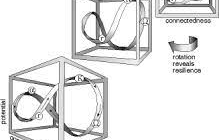
“From Complex Regions to Complex Worlds“ C. S. Holling (2004) ABSTRACT: Panarchy focuses on ecological and social systems that change abruptly. Panarchy is the process by which they grow, adapt, […]
A post from from Ben Woodard at Naught Thought (November 2022): Recently I did two overlapping talks (one in Brussels one online) on the question of the ends of life […]
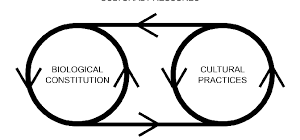
AbstractIn this paper, we argue that the theory of cultural niche construction provides a cogent and fruitful framework for studying and managing human−environment relationships, including our conceptualizations of them. We […]
Introduction In 2020, I got hold of the slim Artscience (2021) by the Malaysian physicist turned writer and speculative designer Clarissa Lee. Subtitled A Curious Education, the unusual format brings together reflections on […]
by Ally Bisshop When Johann von Goethe wrote his 1790 treatise on the metamorphosis of plants,[1] he invited us to read in the form of a plant the signs of […]
An essay by philosopher Amy Ireland. Text source here. Originally published in the exhibition catalogue for Andre Škufca’s Black Market, International Centre of Graphic Arts (MGLC), Ljubljana, 2020. “You’re absolutely right. […]
This paper by Andrew Pickering is a revised version of a talk given at Oxford University, February 2, 2012, as part of a series of Linacre Lectures on “Environmental Governance […]
From the Committee for the Defense and Decolonization of Territories, August 29th, 2021. Published in Ill Will: Preface For four years, the Committee for the Defense and Decolonization of Territories […]
Below Jack Halberstam and Jane Bennett meet in a vibratory encounter designed not to explain or judge but to dilate, to influence, and to disorder. They speak of desire and […]
A World of Many Worlds is a search into the possibilities that may emerge from conversations between indigenous collectives and the study of science’s philosophical production. The contributors explore how divergent knowledges and practices make worlds.
Baruch Spinoza was a Dutch philosopher of Portuguese Sephardi origin. One of the early thinkers of the Enlightenment and modern biblical criticism, including modern conceptions of the self and the […]
From: Lesia Prokopenko Revising the split between the natural and the artificial, xenofeminism offers ways of constructing a viable future from former spaces of violence and inhibition. The Xenofeminist Manifesto is […]
Originally published on THE LIBERTARIAN IDEAL: Collapse Patchworks: A Theory by Chris Shaw The complexity of modern industrial, social and organisational flows presents the headlong perception of dromological speed[1]. As […]
“The true worst-case scenario might be one where we don’t venture out from our safe harbors of knowledge to explore the more treacherous shores of uncertainty.” — Dr. Gavin Schmidt, […]
In my talk GLOBAL WYRDING & DEEP ADAPTATION I played with the idea that there is a wider spectrum of adaptive options for organizing ourselves than what can be gleaned […]
China Miéville, award-winning science fiction author and associate professor of creative writing at Warwick University in England, speaks on “the limits of utopia,” exploring links between environmentalism and social justice […]
From Simon O’Sullivan: “In relation to an explicit politics, this non-engagement with the affective complexities of life means accelerationism offers only a partial picture of the issues and problems at […]
“History is not a race with a finish line — and if we make it one, it’s a game we will lose. Instead, history ought to be seen as a […]
by Bruno Latour The word “network” has become a ubiquitous designation for technical infrastructures, social relations, geopolitics, mafias, and, of course, our new life online. But networks, in the way […]
You must be logged in to post a comment.