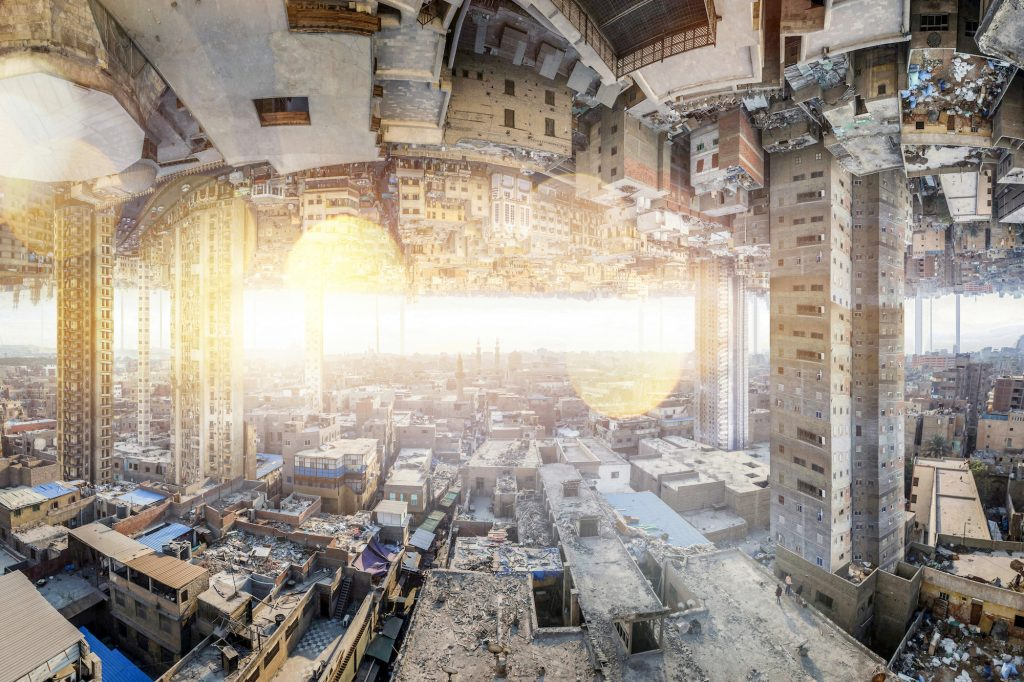
The world, we are told, is ending. Climate collapse, mass extinction, political disintegration—the Anthropocene is branded as a singular catastrophe, the final act of civilization. But what if the end of the world isn’t an end, but a beginning? Something untimely, entangled, and still becoming?
In “Counter-apocalyptic Beginnings: Cosmoecology for the End of the World” (2021), philosopher Martin Savransky invites us to question dominant apocalypse narratives by exploring a way of thinking and living that resists fatalism and embraces the messiness of planetary entanglement. Drawing on Aimé Césaire’s declaration—“The end of the world is the only thing worth beginning”—Savransky reframes social-ecological collapse not as a closing curtain, but as an opening for possibilities and reinventions of self, society, and our modes of co-existing. This isn’t utopia in disguise; it’s an ethics of response in the ruins—an invitation to compose new ways of being together with humans and nonhumans alike. It’s not a blueprint for the future, but a practice of staying with the thresholds of a complex Earth—a planet already thick with endings and becomings, kinships and fractures.
Savransky proposes ‘cosmoecology’ as a means to explore such reinventions. Cosmoecology asks us to look beyond the apocalyptic imagination that reduces the future to a singular trajectory of doom. Instead, it urges us to see that many worlds exist—and many are already ending, transforming, and re-beginning. It’s not that the Earth is dying in one dramatic event; it’s that some forms of worlding—capitalist, extractive, isolating—are untenable and unraveling. In their place, plural, fragile, more inclusive, experimental ways of coexisting could be cultivated.
In this way cosmoecology resists the smooth technocratic fantasies of survival. It doesn’t ask how we can outlive the storm, but how we might live with it—through it—together with the more-than-human others whose worlds are already ending, adapting, or blooming in unexpected ways. This is a practice of composing-with rather than building-over; of attuning rather than extracting; of listening to the murmurs in the ruins, rather than searching for signal in noise.
For Brazilian thinker Thais Mantovani, modern science has stripped the cosmos of meaning, severing us from the ecological stories that once made us feel at home. In her words:
“We need a new cosmology story… a cosmoecology — a story that brings the rationale of how the grand order of events come to be in which we feel at home.”
This isn’t about rejecting science, but about rebalancing it with other ways of knowing—myth, ceremony, embodied experience. For Mantovani, rituals are how we learn to “remember our role on Earth.” Through song, symbol, and story, rituals teach us that we’re part of something larger than ourselves.
In his work on post-Anthropocene design, philosopher Casper Bruun Jensen calls for “cosmo-ecological alliances” that bridge indigenous knowledge, speculative fiction, and ecological science. Instead of seeking consensus, Jensen proposes that we build with difference—collaborating across worlds and ways of knowing.
Such a vision of engagement isn’t about easy solutions. It’s about counter-apocalyptic practice: weaving speculative beginnings out of the fabric of devastation. It’s a call to care, adapt, and experiment, to honor multiple cosmologies, and to foster life not despite endings, but through them. In this way, cosmoecology becomes a method for navigating damaged landscapes—not as survivors of a lost paradise, but as co-creators of new, unfinished worlds.
Cosmoecology is the slow art of worlding otherwise. It’s a practice. A way of learning to live with others—through rituals, stories, grazing paths, artworks, and experiments in care. It’s about staying with the trouble, as Haraway might say, but also learning to find beauty in it. It is an invitation to move alongside the decay of dominant structures while nurturing the compost of alternate futures—futures that grow crooked, mycelial, fugitive.
Original Source: Entangled Ecologies
 synthetic zerØ